SINGAPORE 60's: ANDY's POP MUSIC INFLUENCE IS A PERSONAL MUSIC, MEMORY TRAIL. BLOGGER DOES NOT OWN THE RIGHTS TO VIDEOS, AUDIO TRACKS AND IMAGES. THEY ARE UPLOADED FOR FUN, EDUCATIONAL, ILLUSTRATIVE PURPOSES AND HAVE BEEN CREDITED. BLOG IS NOT SPONSORED NOR ADVERTORIAL IN ANY WAY WHATSOEVER. INFORM BLOGGER OF COPYRIGHT ISSUES AND POST WILL BE DELETED IMMEDIATELY. DO NOT COPY THE POSTS; GET PERMISSION N CREDIT ME IF YOU DO. ANDY LIM LA (NOVEMBER, 2008) -
(新加坡六十年代安迪的流行音乐影响力), SUDI MAMPIR !
Showing posts with label Food Titled Songs. Show all posts
Young *nyonya lady with a BAKUL SIAH [auspicious basket]
for transporting food and sometimes clothing.
UP TO 1,000 VIEWS
15 CHATS, COMMENT
I am not certain if this after dinner *Peranakan phrase has been discussed before but I was always wondering why older family members do not say, "PERGI CHUCHI PIRING..." [go wash your plates] after a meal at home but instead mention, "UNTUK CHUCHI MULUT..." [for washing the mouth] and places a bowl of fruits, cakes and ice desserts on the dinner table.
I realised that the phrase itself explains the reason for the dessert. We need to 'wash' our mouths with lovely Peranakan desserts after dinner. So instead of going to the kitchen sink to wash the plates, the child would ask cheekily, "MAMA, MANA CHUCHI MULUT?" [mum, where's the mouth wash?]. And he gets a huge stare...
So if you are told after a Peranakan dinner, "UNTOK CHUCHI MULUT," it means, "Have your dessert." And they are probably on the table. 👦
Some of these desserts are below...
"Untuk chuchi mulut": [For washing the mouth].
Fruit desserts.
Delicious Peranakan Cakes made of shredded coconut,
glutinous rice and cassava [ubi kayu].
Bo Bo Cha Cha [Bubur Cha Cha]
The best Peranakan dessert ever. Sweet potato pieces with yam cuts and colourful jelly tots. All covered in sweet creamy coconut milk with added pandan leaves for flavour.
*NB:
The term “Peranakan” generally refers to a person of mixed Chinese, Malay and Indonesian heritage. Many Peranakans trace their origins to 15th-century Malacca, where their ancestors were thought to be Chinese traders who married local women who may not necessarily be Malay or Indonesian Malays but speak the language. The language used above is in Bahasa Indonesia.
A nyonya is a Peranakan lady and is usually dressed in a sarong [wrap around batik] and kebaya [colourful embroidered blouse.]
Nyonya Coconut Milk Dessert | Bo Bo Cha Cha
Bubur Cha Cha | 摩摩喳喳 [Nyonya Cooking]
YouTube Video by: Nyonya Cooking
Peranakan Sayang Song on Hawker Food
In Singapore Shanghai Tan SG 🎶 Guitar
YouTube Video from: Singapore Travels Rapture!
[The song on video is not related to Peranakan desserts.]
The ban on plastic bags is a hot topic. Let's keep on highlighting this issue until the world gets rid of them. Below are two inter-related stories and a folk-song about fish dishes.
The above poster was taken off Alexandra Hsieh's Facebook post. Thanks, Alex.
UP TO 2,000 VIEWS 1) Fish in plastic or plastic in fish? Hooray, the world says it's getting rid of plastic bags. It will take some time. Lately, I went to one of the biggest Singapore supermarket chains and asked for a small paper bag. I was given instead a small plastic bag. "We don't have paper bags!" said the lady in charge. Strange.
(The picture is a representation of a dead whale from ingestion of plastic created by Greenpeace Philippines. Credit: Greenpeace Philippines)
2) Whales eat people or people eat whales?
No, whales swallow plastic bags and bottles. And, yes, in a certain country, some people are still catching whales to eat. "We have been eating them for generations! It's in our culture!" says a citizen. I love eating fish but definitely not whales. So be careful not only of fish bones but plastic pieces.
3) Ikan Kekek Folk Song: Here's a Malay folk song I remember that little children sing in kampongs (villages) in the 1960s. It is just as popular today and sung in primary school classrooms in Malaysia and in Malay classes in Singapore.
Ikan Kekek is, according to a website, PONY FISH, pictured above, a favourite fish dish. 4) Songs with Fish titles:
I don't know too many songs about fish in the English language but here are a few: Fish and Chips - Chuck Berry Pisces Fish - George Harrison Saturday Night Fish Fry - BB King
Gone Fishing - Bing Crosby n Louis Armstrong Fish Song - Nitty Gritty Dirt Band Pray For The Fish - Randy Travis
The Fishin' Hole - Andy Griffith Moby Dick - Frankie Laine The Down Easter Alexa - Billy Joel
You can improve the list of fish songs. Splash them on.
WE WANT TO EAT FISH NOT PLASTIC. GET RID OF PLASTIC BAGS!!!
Here's Alvin Oon again with his Christmas gift for all. Just sufficient for that local flavor, appetizing too. Our own SG ALVIN OON recipe. Merry Christmas, Happy New Year to all. Thank you, Alvin, for the video.
In Singapore 60's, Saturday nights were called golden nights because it was the time when pop bands were playing at most of the night spots in Singapore. My friends and I would meet and proceed to one and since we lived on the East Coast, it was usually the Paya Lebar Airport nightclub with its tiny dance floor or the Ambassador at Meyer Road. The latter had a choice of two dance venues. We would go to listen to the latest songs, to dance and to buy a drink or two. There was also a joke running around those years, that boys and girls were hugging each other tightly on the floor rather than dance because the waltz and slow foxtrot were an excuse to do so. Instead of dancing the couples were actually lam-sing (translated lam in a Chinese dialect is to hold orhug). So during quieter moments when the band played sentimental melodies the dance floor would be packed. All the more for a squeeze. Cliff Richard's, When The Girl In Your Arms and The Shadows, Midnight would be the favourites. Soft slow, caressing music...
But there was the rhumba, samba, mambo or the cha-cha. Except for the cha-cha and the off-beat version, the other dance-steps didn't make a difference to many of us. The Drink:
The ladies would usually have a lemonade or an orange juice with ice. For the men, it's mostly beer or an alcoholic mix. It was always Bacardi Coke for me. I've heard of Tequila but never touched it. In fact, it was so popular, that like Rum and Coca-Cola, there was a song dedicated to the strong and crazy drink, Tequila by a group called the Champs. A teetotaller my whole life, I have always stuck to drinking only Barcadi Coke because it was the only drink I knew. Never had a chance to drink other mixes like Gin and lime or Soda and Whisky. Always loved my drink sweet and I was told I could get diabetes if I drank too much Rum n Coke. I knew the taste so well that there were times when the bartender gave me an adulterated mix of the cheapest rum. But I had always asked for another glass, with the real thing and true brown that is dark rum. But without the slice of lemon. Invented at the beginning of the 20th Century, this drink became so famous that it is only known as Rum and Coke in the US, UK, Canada, Ireland, New Zealand, Australia, India and Singapore. In other parts of the world, it's Cuba Libre - not Canta Libre, which is a Neil Diamond song.
Rum and Coca Cola. The Andrew Sisters.
YouTube Video by: Scrambled Eggs 1969.
The Song:
The drink was so well received by the public in Singapore and the world, that almost every nightclub carried the concoction. In fact, there is even a song by a well-known vocal group called The Andrew Sisters. Drinkin' Rum and Coca Cola Go down Point Koomahnah Both mother and daughter Workin' for the Yankee dollar Oh, beat it, man, beat it...* It is a very old song with a Calypso beat and composed in 1945 but became popular through the years as the drink would have. Singers like Chubby Checker, Julio Iglesias and Wanda Jackson had recorded it. The original version by the Andrew Sisters had been recorded three times on three different labels, Decca, Capitol and DOT.
And Andy [blogger] compered one evening with
the Velvetones playing Shadows and Cliff numbers.
At another hotel, dancing and drinking Rum n Coke:
Singapore rock guitarist Grandma Mary of You Tube fame (3 million plus hits) organised a party. Former Rediffusion DJ's Tan Swee Leong, Larry Lai, pianist extraordinaire Jimmy Chan and yours sincerely came with wives and friends Selina, Sandie, R., John, Edmon and Dennis. There were some other guests invited by Mary. The spread then; Mary, mee-siam, music and merry mayhem throughout the evening. There was a lot of food and drinks for all as we tasted the famous mee siam cooked by Swee Leong. His dish was the hightlight of the evening. It was delicious and a period of slurping time with the usual clinking of wine glasses. Mary was generous with her supply of catered, quality dishes on the table.
Since the guests were entertainers, the night was filled with songs as Jimmy accompanied them. A, You're Adorable, Walking My Baby Back Home, April Love,C'est Si Bon andpiano instrumentals were played with selections from pop musicals like Evita,The Eddie Duchin Story and others. As usual, Swee Leong was the life of the party with his special rendition of Perry Como's 1949 hit, A, You're Adorable. Larry too, after much much persuasion, contributed a song. The highlight was Jimmy's version of, To Love Again, the theme melody from the movie, The Eddie Duchin Story, based on Chopin's E Flat Nocturne. Pity Grandma Mary did not chip in with her solid guitar solos or else we could have enjoyed some Santana music. Other melodies from both the 50's and 60's flowed throughout the evening and filled the night as Jimmy's dexterous fingers danced and skated on the ivories. The night ended too early but it was already one o'clock when we went home to hit the sack. Thank you gracious Mary for the occasion.
1. On 'Foodage' Documentary November 2012: Thursdays Channel 5 at 9pm.
UP TO 2,400 VIEWS, 20+ COMMENTS & CHATS
"In the 60s, hawkers roamed the kampongs and the streets of urban Singapore. The children who grew up in this foodscape share their memories - the roving calls of these hawkers were music to their ears and fed their seemingly insatiable appetites. Their memories - both pungent and poignant - are set against a turbulent backdrop of merger and independence, lawlessness and unemployment and the Big Fire.
2. With The Silver Strings in 1965.
The food on offer in this episode includes Indian rojak, wanton mee, kaya bread, mee siam and tuckshop tidbits.
The Singaporeans sharing their stories, include Jerome Lim, Peter Chan, Shak Kadir, Yeo Hong Eng, Andy Lim, Toh Paik Choo, James Seah, Lam Chun See, Aziza Ali, Dick Yip, Ong Yew Ghee, Ivy Lim-Singh, Geraldene Lowe-Ismail... Foodage Facebook." Some of those mentioned are in the pix.
3. Indian rojak used to ply the streets in Singapore.
The images were captured from Foodage TV Episode 2 (shown on OKTO Channel) where Andy Lim described how he waited outside the five-foot way of his home for Mr. Sultan's Indian rojak and the wonton mee pushcart man with his bamboo stick tick-tock call.
4. With Shirley Nair on Philips Records (now Universal Music Singapore).
He also recalled the pop 60s music explosion when Cliff Richard and the Shadows invaded Singapore with their twanging guitars and new Fender sounds. The heat generated by the music was so intense concert patrons had to buy ice-cold, bottled, soft drinks like Sinalco, Green Spot, Framroz, Red Lion and F n N drinks (image 4) to cool their hot and soaking bods.
5. Kacang puteh or fried peanuts with other tidbits.
Caught in this exciting music tsunami, Andy joined The Silver Strings (image 2) for two, short but exciting years where they performed at nightspots, lounges, restaurants, hotels, and the Vic and National theatres. When he left, Shirley Nair held the stage, the group contracted with Philips Singapore to become recording stars (image 3).
Back to the documentary, Andy discussed the close proximity of his home to the Queens' Cinema where he watched movies from the 50s and 60s and how the kacang puteh man stood outside the Cinema to sell his array of peanut goodies to the patrons.
As MC with The Velvetones: music first, food n drinks afterward.
All images from Okto Channel screen grabs: Foodage documentary produced by SittingInPictures. Thanks to producer Chang Soh Kiak. Images 2,4,6 were provided by Andy Lim.
"Food n Singapore 60s Pop Music" airs @ 9pm, Thursdays, November 2012 on Channel 5 (StarHub at 102 and 155HD).
Here are some food songs served on local Singapore platters. But they are not to be eaten. So let's visit this hideaway called Pop Inn, hosted by The Quests. Watch Your Step as we go in where other band members will be waiting to dish out their speciality.
The first is an original composition by Quests bassist Henry Chua called, *Tea Break. It is the flip side of their EMI single CHK 1050.
Then 5 of D'Starlights boys, who are actually from the Philippines, will provide their packets of *Peanuts to the guests. No ordinary peanuts these because you can't buy them For A Few Dollars More. Other dishes on this EP platter include: Something On My Mind and I Believe. (EMI ECHK 585).
Veronica comes with her original serving ofa *Lollipop each for her guests. Composed by Singaporean Patrick Seet, Veronica sings,
Lollipop, I want nothing but lollipop/ Won't give anything for lollipop/Cause nothing can be better than lolli-lolli-pop-pop... Record from (Philips ME - 0192 - VE).
No cakes, curry-puffs or finger-food during this tea and sympathy and as Jade And Pepper remark, Hey It's Happening Again, they provide, *Coffee, Toffee, Squares(Baal Records SP 1005). Rounding off the afternoon are The Surfers withbottles of *Honey. This EP platter has Hooray For Hazel, Mony Mony and Answer Me. These two groups look like they are from the October Cherries. Ah well!
At the end of it all the Watermelon Man delivers his red and green fruit accompanied by the McCoys and Stevie Lorraine. But nobody leaves as they go Yakety Yak through the night. Such Moments for the party, according to Stevie are rare indeed. (EI ECHK 591. Philips ME-0185-SE). If you know of other Singapore recordings with food titles please contribute. *6 Food songs include originals and covers by our Singapore artistes.
(This posting, with 4 other postings on food, is in conjunction with the Sitting In Pictures documentary, FOODAGE, where Andy Lim has appeared in Episode Two discussing his mother's cooking, hawker food and music in the 50's and 60's. Chang Soh Kiak produced.) Images: Private Collection and Google.
There are songs written in Bahasa Melayu (Malay) from Singapore and Malaysia that describe Geylang Serai in the 50's and 60's. Geylang Serai, which lies in Eastern Singapore, was a predominantly Malay area and people frequented the open street and wet markets to buy condiment and fresh ingredients for their home cooked meals.
Ahmad C.B., who originally came from Indonesia and lived in Malaya had been composing songs since the 40's. He wrote this one that re-lived the busy scenes of Geylang Serai in the evening. The Taj Cinema he mentioned in the song was a rendezvous for many young Malay couples who frequented the place to watch movies. A parallel, among the more westernised Singaporeans, was a similar meeting place in the city - the Magnolia Milk Bar at the Capitol Cinema, near the junction of North Bridge Road and Stamford Road.
Geylang Waktu Petang(Literal translation in blue) Di waktupetang di Geylang Serai: In the evening at Geylang Serai, Terang benderangsungguh-lahramai: Bright, cheerful and crowded, Tua dan mudamiskinataukaya: Old and young, poor or rich, Semuanya adaterdapat di sana: They are all there.
Begitu banyak orang jualan: So many people selling their wares Sehingga sesak sampai ke jalan: Overcrowding on the roads Bermacam barang terdapat di situ: Lots of things to be found Kasut dan baju 'macam model baru: Shoes and clothes of the latest fashio Kalau penat carilah bai serbat: If tired, look for the Indian drink hawker Di dekat Panggung Taj: Near the Taj Cinema
Di situ tempatkalaunakbuah: That's the place for fruits Di situ memang murah: That's where they're cheap. Kalau nak kuih tak susah pilih: If you need cakes, easy to choose.
Berbagai bangsa yang lalu lalang: The many races that frequent the place Sungguh lah puas mata memandang: Satisfy their eyes Itulah kisah Geylang waktu petang: That's the story of Geylang in the evening Sungguh cukup ramai di Geylang Serai... Very crowded is Geylang Serai.
Thanks to Ms Chang Soh Kiak, producer: Foodage documentary.
Watch FOODAGE tonight and listen to the sound and music of food hawkers as they call out their wares in Singapore 60s. There's the Indian rojak (spicy salad) man and won-ton mee (noodles) man. The former shouts his food on the five-foot ways of Geylang Road while the latter has an assistant who creates a *percussion solo on his bamboo sticks (yellow image above). They are music to the teenager's ears who hops out of his home to patronise the vendors and savour the yummy treats.
*Comparable to the drum solos of Gene Krupa (from the Benny Goodman Orchestra) and Brian Bennet (from The Shadows).
Media Corp. FOODAGE Documentary: Octo Channel Thursday Nites: 10.00 pm.
Elvis Presley sings 'Crawfish' (from Paramount Studios/Elvis Presley Estate)
Street Hawker (from National Heritage Board Archives Singapore)
UP TO 9,000 VIEWS
35 CHATS, COMMENTS
Singapore Memories:
Singapore street hawkers or vendors in the 60s have been highlighted as being unique and special. Many stories have been written about them and one author, Chan Kwee Sung in his book, One MoreStory To Tell, highlights the street laksa (page: 44) sold in the Katong area in the East Coast and the hot porridge (page: 49) in downtown Chinatown. These memories are etched forever in the minds of those who have lived the period and seen the food-sellers.
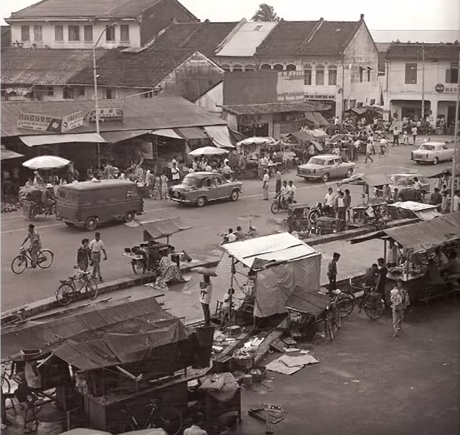
I remember my own encounter with these street hawkers along Geylang Road in Singapore where they advertise their food using their own unique/special hawker calls to draw out customers from their homes.
.
The meat-bun man will shout, "Char siewpau..." as he pushes his cart filled with hot, steaming buns in containers balanced over a charcoal fire. Then there's the chicken porridge man selling his, "Kaiiiii choke."
.
The won-ton noodle hawker's assistant who strikes a small bamboo piece with a stick, using a rhythmic beat to announce his delicious meal for 30 cents a bowl. "Tock, tick, tock, tick, tock, tick, tick, tick, tock..." I even recall the Indian rojak (spicy salad) who shouts his ware along the pavements of Geylang with, "Rojak, rojak..." Street sounds we call them. Or food sounds?
Elvis Presley singing 'Crawfish' as the lady hawker on the streets of New Orleans sells her food.
Connection:
The food hawkers mentioned by our local writers are not uncommon in other parts of the world (images). There are street hawkers everywhere and Singapore is no different. In fact, the opening scene of the Elvis Presley movie, King Creole (Paramount: 1958) depicts street hawkers selling their wares in downtown New Orleans in the 50s. (please watch the video above). After the film title, Elvis duets with singer Kitty White to sing Crawfish.
Elvis describes the catch:
"I went to the bayou late last night
There wasn't no moon but the stars were bright
Put a big long hook on a big long pole
And I pulled Mr Crawfish outta his hole
The street call:
Crawfish, craw-aw-aw-feeesh!
See I got 'em see the size
Stripped and clean before your eyes
Sweet meat look good
Fresh and ready to cook...
Craaawfeeesh!
The sales pitch:
Now you take Mr Crawfish in your hand
He's gonna look good in your frying pan
If you fry him crisp and you boil him right
He'll be sweeter than sugar with every bite
Crawfish..... crawfish...
(Song credited to Fred Wise/Ben Weisman, King Creole Album 1958)
How cooked food from a street hawker is carried from the ground-floor up, with ease and dexterity. Thanks to Michael Lee for the picture.
Whether it's food culture or otherwise, the world has been connected a long time ago. Like the funeral bands in New Orleans and our own Singapore funeral marching bands - the similarities are astounding.
.
Perhaps there is one difference between Singapore's street vendors and those from the West; they are more imaginative and sing their wares.
. Can you remember other popular 60s songs with food as a theme?
A crawfish street hawker in the 1950's calling out to sell her fresh seafood, like in Singapore those years.
Images: 2.
Paramount Studios/Elvis Presley Estate. 1/3. National Heritage Board, Singapore.
Original article:
Andy Lim.
Book Quote:
One More Story To Tell - Memories of Singapore - 1930s to 1980s (Chan Kwee Sung: Landmark Books, 2005).
.
(This posting is for Derek Tait who's just joined as a Follower.)