Showing posts with label Pirated Records. Show all posts

Thursday, November 03, 2022

Pirated Vinyl Records, Bootleg Or Fakes: On Sale In The 60s

  UP TO 1,100 VIEWS  
22 CHATS, COMMENTS

Bootlegs are not legitimate commercial releases and are illegal but some collectors want them. It is true that all illegal items - not just records - are hard to advertise, buy or sell. So most bootlegs have little value.

In the 1960's they were called, pirated records.

They come in several categories though. Some bootleg LPs often feature tracks that have not been commercially released because the recordings are stolen ones. Some are illegal recordings of live concerts. 

EPs include re-releases of rare or valuable 45s. Some bootleg 45s are exact copies of rare records with the original label graphics and numbers - these are known in the industry as counterfeits. In Singapore 60s, a record does not need to be rare. As long as it sells well, a bootleg copy is available.

During blogger's search for vinyl, he comes across many bootleg copies. Some of them are so common that they are worthless today, but some of these fakes are being sold in the market for a higher price. At the end of the day it depends on how much a buyer is willing to pay and how badly the seller is willing to part with the bootleg for the amount involved. 
A cheap bootleg vinyl EP from Sungei Road, 
a famous but defunct flea market.

The above vinyl, from a flea market, costs S$2.00 but may cost more today. It has a unique cover with our former Singapore sweetheart Heather's most popular song, Love Is Blue. 

But what makes it special is Cliff Richard's pasted photograph below with the song Congratulations. Together with Green Tambourine, Heather (who was with The Thunderbirds and Diamonds Four), sings Kiss Me Goodbye. And the label is Hi Fi Record without a serial number. They could have been more imaginative.

Comment anyone? 
Is this another counterfeit, this time of the Monkees. 
It has a record trade mark or company, but
no song titles and no photographs, only sketches.

Click link to read:


Click Comments below for more on this topic.


Image/original article: Andy Lim.

This posting was originally dated 30.3.2010.

Monday, February 21, 2022

Vinyl Records Made In Singapore: Spaghetti Western Theme Songs: Fake/Bootleg


The Good, The Bad, and The Ugly:
Hugo Montenegro & Orchestra. 
Video by: jazzman amos

I have a collection of vinyl records that are actually bootleg [not original] ones and bought them when Sungei Road was around. Very cheap too, about one dollar each. 


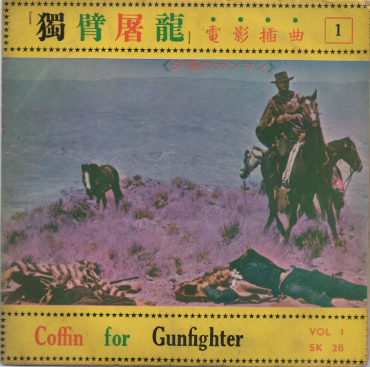
I accidentally dug out two 7 inch vinyl records, the first is a single (image 1, 2: black/white) and the other an Extended Play (image 3, 4: yellow).  The single is a scratched and used single vinyl with a torn sleeve, while the other is a shiny looking bootleg E.P. And I've never played them before.

While the single has the hits, For A Few Dollars More and Coffin For A Gunfighter, the E.P. has the same two numbers plus Titoli and La Resa Dei Conti on the front cover. These titles were translated as, The Killer and Fistful of Dollars.
The Single

Both Clint Eastwood and Lee Van Cleef came alive with Ernio Morricone's iconic music when I put the single on the turntable and Coffin For A Gunfighter came loud and clear on the speakers. 

With the second track, the whistling from For A Few Dollars More took me back to my youth as the sound filled the room with what many knowledgeable fans during yesteryear would term as spaghetti western instrumentals.

For the uninitiated, these instrumentals were so popular that even our Singapore record producers in the mid 60's went full gear to employ part-time session musicians to record the songs so they can make a few dollars more. 
The particular single I have, boasts Charlie and His Orchestra printed on the cover.  I remember very clearly there was also a Charlie and His Go-Go Boys when a-go-go music was in vogue and Charlie and The White Cloud Orchestra when the Chinese song White Cloud was popular. 

In fact Charlie and his many orchestras became so popular that his records flooded the local market in the 1960's and 1970's as many instrumental hits were produced. But was the orchestra actually music from the keyboard with its variety of gadgetry sounds?  You know, push a button, trumpet sound, push another guitar sound, and so on. Was it a one-man show?  

This particular single (i.e. with two songs) is a Star Swan Brand and sold over the counter as a legitimate cover version. As I explained earlier, mine is a near new record.
The E.P.

The Extended Play (King Records) looks brand new too and seemed untouched, and unblemished on surface; it was invitation enough to be played. The cardboard sleeve cover, however, is old with some dirt markings. Even a clean-up job did no good. Strange.

Then came the revelation. When I played the first track, I was shocked to find more than 5 repeat grooves. Thrashed to bits, it was fit for the trash can. I had to abandon the track but continued with the second one. Perfect. 

How much money these pirates made is hard to tell but the amount of illegal vinyls generated those years were tremendous, so much so that they were in the market for sale even before the genuine pieces were out. 
The reason why people were buying these records instead of the original ones was because they could get four songs on one vinyl piece. It was convenient and cheap. Furthermore, these movies and music made up the Dollars Trilogy that were a draw. (The movies collected more than $55 million from the big screen. It is still big money today, what more in the 60's).

Starting with A Fistful of Dollars (1964), For A Few Dollars More (1965), the songs from spaghetti westerns came full circle with, The Good, The Bad and The Ugly (1966). To cater to the large Chinese listeners, the pirated version printed the language to attract them for easy reference and sale.

And, as usually the case, by the time genuine Hugo Montenegro and His Orchestra (RCA) came on the dusty streets with holstered guns, the big duel was over. Mr. Bootleg won! The reward money was worth it.

And cheap recordings done with one person on an electronic keyboard!
*bootleg = a pirated copy, usually with sloppy sleeves, typo-errors, etc.

Images: A Private Collection.
Videos: You Tube from Ukulele Orchestra.


The Ukulele Orchestra of Great Britain
The Good, The Bad and The Ugly. 
This version will rejuvenate the funny bones. 
Watch to end.

Monday, May 02, 2016

Pirates, Bootleg, Fake: What's Genuine And What's Not? Help!


1910 Fruit Gum Company. 
Simple Simon Says, 
Video by Ken Schilling.

UP TO 1,000 VIEWS

Records @ Two Dollars Each:

When Sungei Road was at its peak not too many years ago I would visit the unique place at least once a month to buy old vinyl records from a guy called George. A tough, fierce looking man with thick, long wavy locks George would be selling both LP's (Long Play records) and EP's (Extended Play records) at two dollars a piece. Whether they had torn covers, new covers, scratched and dirty surfaces or shiny and clean ones don't matter. They all cost two Singapore dollars each.  

In his collection you can find an array of English songs, Chinese songs, Indian songs and the collectors' Malay EPs available. Whatever you need and if you are lucky enough you may get them. I would sit on a stool and choose the records I wanted. 
Amidst the deluge of piring hitam (Malay language: black plates) I realised they were a bargain. At first I would look for the genuine pressings but later found that the pirated ones were more interesting and unusual. With their pimples, sores and imperfections, I fancy they could be collectors items soon. So here you are looking at only a few from my collection which I started in 2010.

Unless both records and covers are in your hands it is sometimes difficult to distinguish between an original copy and a pirated version. Let's have some fun.
Record Sleeve Image 1 and 2:

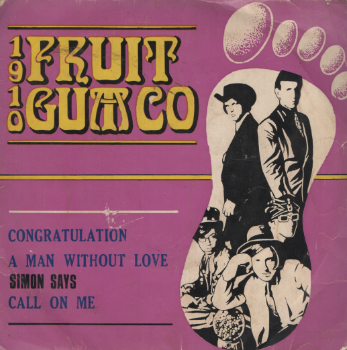
It is obvious which record above is the genuine one i.e. the real McCoy and which is the pirated version.  The first record cover is from Buddha Records while the second one is from a local syndicate called Oscar Record.

The clarity of print, quality graphics and professional artwork show the way to a beautiful illustration that befits a record sleeve. These attributes the reader will notice in the first picture.

In the second picture, the give-aways include the wrongly spelt, Congratulation, different print colour to indicate the group's original song and three songs that are not by the bubblegum band. Poor design and cheap printing was the order of the day. Worse, the vinyls themselves are of poorer quality, thick and easily scratched. 

In case the reader is not from the same generation, A Man Without Love and Call On Me are by singer Engelbert Humperdinck,  and Congratulations sung by Cliff Richard. Only Simon Says is by the group 1910 Fruitgum Company. 
Record Sleeve Image 3 and 4:

This second pair is not too obvious, or is it? The RCA logo could never be a fake but the R Record might. It is doubtful if pirates would dare to gamble and use the famous trademark when they can produce their own. So which is the real thing? Strange but true, the first sleeve is the pirated version.

Yes, this time around could you guess the truth i.e. which is the diamond and which is the cut-glass?  Look carefully. Why would the pirates want to sketch the faces when they can get the real photographs for free.

And, by the way, one of the above E.P. has these songs in place, Theme From The Monkees; Let's Dance On; Last Train To Clarksville and This Just Doesn't Seem To Be My Day. They are all Monkees hits. So there!
Record Sleeve Image 5 and 6:

Pirated vinyls were common in Singapore in the 1960's when recording studios were fully utilized to press all kinds of songs that were at the top of the pop parade. As long as they made their money, nothing else mattered. 

These pirated records were massed produced by the thousands. I remember Henry Suriya (brother of Robert Suriya from Naomi and The Boys) telling me once that when his fans came up to him to ask for autographs they were handing pirated copies of his records, not the original ones. But he signed them. 

They were popular because the buyer got four top hits of the season on one disc for the same price of an original EP, which would probably have one hit. Surprisingly, according to local recording artistes from the 60's, these copies flooded the market earlier than the originals. 

The 6th image above shows four hit songs one one vinyl disc for about S$2.80 cents. There's Elton John with Your Song, Too Young To Be Married (Hollies), She's A Lady (Tom Jones) and Rose Garden (Lynn Anderson).  Buying them on singles would cost about S$1.80 per piece with an unknown B-Side. Four songs would cost nearly $8.00. 
The 7th image above is another pirated record of Cliff Richard (poor Mr Richard who was so popular in the 60's, had himself recorded so many times by pirates that they are richer than him!) There are only three songs on this Apache fly-by -night trade mark together with Cliff's number Flying Machine. The other two songs include Soldier's Prayer (Oscar Harris) and Chirpy Chirpy Cheep Cheep (Middle of the Road). The sleeve cover is just a sheet of writing paper, easily crumpled.

BTW George is still at Sungei Road and if you haven't been there lately, *Robinson Petang (Robinson's In The Evening) occupies a much smaller area now.  But he hardly sells records anymore. 

*Sungei Road is also called Thieves' Market. It used to be a tourist attraction but many people from other countries still come today to buy up both Asian and local records.

Images: A Private Collection.

Sunday, December 05, 2010

Songs About Singapore: Why Our Music Appeals To Western Ears.

On A Little Street In Singapore:
It's a well-known fact. A song about Singapore has been covered by top US bands and groups. And it was covered a long time ago. On A Little Street In Singapore is a very old song by Peter Derose and William J. Hill and was popular in the 30s and 40s.

            Manhattan Transfer: 'On a Little Street in Singapore' - Top of the Pops 1978

Dorsey, James, Sinatra, Miller:
It was revived in 1978 by the Manhattan Transfer and when the group was here, the song became their trademark. Besides the Manhattan Transfer, Jimmy Dorsey, Harry James, Frank Sinatra, the Ames Brothers, Bert Kamfert and Glen Miller have covered it.

Exotic East:The lyrics are typical of songwriters from the West when they interpret the exotic East, 'We'd meet beside a lotus covered door' and 'My sails tonight are filled with perfumes of Shalimar/With temple bells that guide me to her shore...' I am wondering if the cruise ships currently plying our shores are aware of this practice.

Suzie Wong:
Would be a great idea to boost tourism but shouldn't we have church bells too? And Christmas bells? Songs about Asia by Westerners will always have this cliched viewpoint and Singapore is no different, a sunny island in the mysterious East with its slant-eyed, cheongsam chicks called Suzie Wong. By the way, have you seen 'a lotus covered door' lately?

Charlie Chan:
To be fair, On A Little Street is a great song from the 40s, with its razzmatazz and jazzy, finger snapping composition but I am not too sure about the lyrics. Seems like Charlie Chan is still lurking around in some corner with his moustache and greasy hair. And Singaporeans are still wearing coolie-hats and samfoo!!!

Bootleg CDs:
Is this the Singapore some Western listeners are interested in, when they buy bootleg CD selections lifted from 60s Asian music vinyls? No wonder our 'older' songs are still selling. All for the wrong reason. Or is it for the 'Wong' reason?

Click: Movie Theme Songs Label below to check similar article about song Sayonara. (July 3rd, 2009).

Image/Movie/Singapour: http://www.doctormacro.com/
Original Article: Andy Lim.

Friday, June 04, 2010

Asian 60s Music Hits Appeal To Western Ears

CDs like the above (image) are re-issues of 60s music recorded previously by our local Singaporean, Malaysian singers and bands who have put in much time and effort to press them on types of vinyl. Now, these compilation CDs are for sale on the internet. Without copyright and free legal advice to help our musicians, nothing can really be done to channel the earnings to them. But the production of these yesteryear hit collections has been in practice for many years. So who cares anyway.

The writer below explained that the selection was his "favourite find" and he wasn't concerned which of them were hits but rather, which ones appealed to "this pair of western ears." Even the susu chap junjong jingle (Milkmaid Milk advertisement) attracted the writer's western ears. It is given away as a 'bonus' track. Interesting indeed. Perhaps the compilation is done and sold just to cover the cost?

(Original article above: Andy Lim.)
                                   Rocky Teoh: Malayan Elvis Presley: Record Selection

Read the story below about this enterprising person who came to Singapore 11 years ago to buy up the types of vinyl:

“Funny thing happened to me back in 2001, during my first trip to Singapore. I was in a clothing store in Causeway Point, and an old ‘60s tune was blasting out of the stereo speakers. It sounded like your typical ‘60s pop hit, but the lyrics were sung in Malay! I was entranced, and wouldn’t be satisfied to just hear it just once. I spent the rest of my trip combing the local antique stores and flea markets, grabbing all the vinyl I could find.

My first purchase was The Mysterians’ Forget the Time b/w My Girl Les, found at an antique store on Orchard Road. The cover, featuring the band wearing black masks and standing in the green background, is such a classic that I spent a few weeks admiring it before finally purchasing a turntable so I could hear it. But when I finally did, lo and behold, an obsession was born.
                                          Charlie and His Go-Go Boys: by llvlalaysiaboleh

Nine years and five overseas trips later, my collection now boasts more than 600 rare titles from the region, which also includes Malaysia and Indonesia. In this first volume, I present a handful of my favourite finds. Some of these bands experienced regional success at best, while others disappeared after one or two recordings. Very few left behind any written history.

I didn’t concern myself with which songs were hits, but rather which ones happened to appeal to this pair of western ears. I have included a variety of tunes, from rockers to ballads, covers and originals, all sung in a variety of native languages. A few instrumentals have been thrown in for good measure. Now on to the music, Let's A Go, Go, on Silver Tortoise. CD."
  
無可奉告 鐘玲玲 Betty Chung 1968 - from Francisca Raquiza.

Tracklist:
#1 Flamingo By The Bees, #2 One To Nine Walkin' By Patrina, #3 The Second Spring By Hai Fei, #4 Just Because By The Dee-Tees, #5 You've Got To Move On By Leroy Lindsay with The Mysterians.

#6 Mean Woman Blues By Rocky Teoh, #7 The Girl From Alishan By The Blue Beats, #8 Let's A' Go-Go By Charlie and His Go-Go Boys, #9 Oh! Salina By M.Ishak Dengan Five-55, #10 Things We Said Today By S.K. Pauline.

#11 Bang Bang By Betty Chung, #12 Wooly Bully By Charlie and His Go-Go Boys, #13 Then I Kiss Her By Lotus Liew, #14 Mun Li By Orkes Tropicano, #15 Let's Dance By Lotus Liew.

#16 These Boots Are Made For Walkin' By Charlie and His Go-Go Boys, #17 Swim Swim Swim (She and I) By The Spacemen, #18 Merindu Kasih By The Click IV Dan Jaffar-O, #19 My Girl Les By The Mysterians, #20 Dream Wonder By The Tones, #21 Beli-lah Susu Chap Junjong (Bonus track) By Malay-Tamil-Malay.

Just wondering. Collecting the types of vinyl can be an eye-opener because of the artwork on the sleeve covers but listening to some of the songs? That is a problem. Not too sure about Betty Chung's, Bang, Bang.

The article above flagged by Mark Wong.

1) Another similar article posted on Sunday, March 14, 2010:

Sunday, March 14, 2010

Girls In The Garage? How Others View Our 60s Asian Lady Singers. Stereo-Typed Again?

Way back in 1999 on 13th February, an album of Singapore 60s English and Chinese pop songs were released. Many enthusiasts would have realised this but just in case... On this 13 track CD, we have an interesting selection that includes:
.
1 Penny Lim & The Silverstones - Kung See, Kung See, Let's Be Happy 2 Rita Chao & The Quests - Hanky Panky 3 Lara & The Trailers - Sugar Town 4 Nancy Sit - Love Potion #9. 5 Rita Chao - Yummy, Yummy, Yummy *6 [unknown] - If You Ever Go 7 Naomi & The Boys - As Tears Go By 8 Naomi & The Boys - I'd Like to Know 9 Rita Chao & The Quests - How to Catch a Girl 10 Nancy Sit - Hanky Panky 11 Sakura & The Quests - My Boy Lollipop 12 Nancy Sit - Come Back When You Grow Up 13 Nancy Sit - Fever.
.
*The Silver Strings & Shirley Nair. (check Comment by Steve Farram).
WHAT OTHERS SAY:
.

Below is an article posted by Mack Hagood on February 22, 2004 09:24 pm by The Far Eastern Audio Review:
.
"As Sofia Coppola's Lost in Translation heads for the video stores and awards shows, some are having second thoughts about the film. Kiku Day's scathing indictment in the U.K.'s Guardian and other late reviews have held up the film's jokes about Japanese food, stature and English pronounciation as examples of anti-Asian racism.
.
Coppola, who lived in Japan for a time, is probably taken aback that a film she intended as "a love letter to Tokyo" has been interpreted as racist. The key to the controversy is in the film's title: Lost in Translation is about the alienation, wonder and--yes--humor to be found at the limits of people's understanding of one another.
.
The problem is, like her two protagonists, the director doesn't push those limits hard enough and little beside the wacky and exotic make it through the filter of her Western gaze. This isn't racism (it lacks the intent and cruelty that word implies), but it is a missed opportunity to see the Japanese on their own terms.
.
Which brings me to The Girls in the Garage Vol. 9: Oriental Special. Again, the (somewhat unfortunate) title tells us a lot: This installment of the 60's girl rock series brings us wacky finds from the flea markets of Singapore.
,
Compiler "Bradley Ghoulstein" is knocked out by the hilarity of what gets lost in the Chinese translation of Western pop, so the filter we get here is in the playlist, which is comprised almost entirely of familiar American songs. The goal here is a cool, funny addition to garage collections and on that level it works well.
,
Rita Chao and the Quests' version of "Hanky Panky" (one of two versions on the CD) is brilliant. Greasy-dirty guitar tone, funky drumming and Rita's charming vocal delivery--complete with "R" and "L" mixing and implied lesbianism when she doesn't change the gender of "her baby" in the lyrics--all conspire to create the perfect party single.
.
Nancy Sinatra's "Sugar Town" sounds great in Chinese by Lara and the Trailers; "Love Potion #9" fairs a little poorer in the shaky hands of Nancy Sit and her band. Yes, that's right... Nancy Sit, a Nancy Sinatra knock-off responsible, by the way, for the oh-my-god-it's-so-bad-turn-it-off-now second version of "Hanky Panky" on the disc. Cross-cultural weirdness abounds on this record and it's damn fun.
.
Racist? I can't see how. Reductionist? That's a different story. Mr. Ghoulstein's liner notes seem to be made up of whatever he could glean from the album covers. Intrigued by their beautiful version of "As Tears Go By," I checked the notes for information on Naomi and the Boys and learned they were "Malaysian (Indonesian?)" with vocals "sung in almost perfect English... damn."
.
A quarter of the tunes here belong to Nancy Sit, not because she's good, but because she's funny. But by far the best song is an original, Penny Lim and the Silverstone's "Kung See, Kung See, Let's Be Happy." The liner notes call it an "undescribably baffling masterpiece of New Year's (Chinese of course) bubblegum." I can't improve on that description. It's Chinese 60's pop on its own terms - incredibly weird and enjoyable. It opens Oriental Special and the rest of the CD pales in comparison.
.

Lost in Translation and The Girls in the Garage Vol. 9 both view Asians through the filter of Western culture and divide them into two groups: hipsters who get it "right" and (much preferred!) amusing folks who don't. In either case, the Westerner is really looking at himself--whether it's the flattery of good imitation or a funhouse mirror.
.
I don't condemn us for being this way--all cultures are self-obsessed, after all. But when we stick only to the safe confines of the Tokyo five-star hotel and the goofy Singaporean cover versions of our own songs, we miss out on true Asian originals and the chance to push beyond the limits that separate all of us different styles of human."
.
Image/article by: Mack Hagood who is currently completing his MA thesis in Folklore and Ethnomusicology at Indiana University. He is creator and editor of the Far Eastern Audio Review. From: Folklore of East Asia Folklore Forum 38.1 (2008).
.
Listen to the songs on You Tube. Do you have comments to make or do you have a copy of the CD and Bradley Ghoulstein's liner notes? Would be an interesting read.
.

Monday, June 22, 2009

(4) The Trailers With Henry - Copyright Laws


"Even to this day, the protection of artistes' work continues to be an arduous task. I wonder how many local artistes know what is copyright. Why is copyright important? How long does copyright exist to cover the artistes' works? My personal view is: Anyone who takes another's musical works without the permission or compensation has infringed copyright laws.
Although I contributed so little, I am honoured and proud to be part of Singapore's pop history. The places visited; the many friends I've made will be things, "I'll remember and treasure all my life." Henry Suriya.
This article is the final part in the series.
Image/Article: The Trailers and friends. Henry Suriya Collection. All Rights Reserved.

Sunday, June 21, 2009

(3) 60s Music Decline - Money Piracy Culture

"The boom in the local recording industry created an avenue for "pirates' to thrive. Recordings of popular artistes were found evrywhere on many different labels. There were times pirated copies could be found in shops even before the originals hit the market. Unbelievable, frustrating and sad, yet nothing could be done.

Henry Suriya
At that time, both Malaysia and Singapore were not protected by copyright laws. Privacy was rampant in some Asian countries. A huge portion of the artistes' earnings were take away by these crooks.
The 'down syndrome' started to take place, beginning with fewer stage shows and followed by the disappearance of shops that sold musical instruments. Jobs were lost. Tea-dances were banned as pop music was regarded as 'yellow culture'. The music scene slowly but surely slipped into slumberland."

Many of our local artistes were echoing the 1964 hit song by the Animals - We Gotta Get Out Of This Place. Some of them did just that and (while some got out of the industry), others moved out of Singapore."
Henry is brother to Naomi and Robert (singer/composer) of the Naomi & The Boys fame. FYI: This family has 12 of their songs on the 100 Greatest Singapore 60s Definitive Collection that was recently released.

Image/Article: 3rd part of a series by Henry Suriya.
All Rights Reserved.

Friday, May 08, 2009

Naomi & The Boys - 50 Songs For 60s Music

Henry, Robert and Naomi are part of the famed Suriya family that had engulfed Singapore 60s music. While Henry recorded his music solo, Robert and Naomi recorded as a group called, "Naomi and The Boys".
But they don't really need an introduction because the songs, "It's All Over" (image), and "I Know" both originals, were right at the top of the Singapore and Malaysian Hit Parade Charts then. Besides, Naomi's, "Happy Birthday Baby," was more popular than other cover versions.
Robert Suriya, singer, songwriter and lead guitar with The Boys had Peter Thomas on rhythm, Moses Tay on bass and Alphonso Soosay on percussion. This final re-grouping of passionate musicians went on to produce and record about 50 songs altogether.
While on the hunt for Singapore 60s vinyls, I managed to buy a few of their records, but all of them are bootleg copies. The copyright laws were not in place in Singapore during the 60s and had affected people in the music industry significantly.
More about Henry, Robert, Naomi and The Boys in future postings.


Friday, March 13, 2009

Singapore's Siglap Five. Hit By Pirated Records


EARNING A LIVING

The above image was not specially created on the scanner. It's a genuine record cover. Two for the price of one. Four songs on one record instead of two in one single.

Wow, it's a deal and you get this record all over Singapore in the 60s. Check out the label again. Nothing will be revealed. Now everyone's seeing red.

Is it bootleg? "Tell Me If It's True?" asks Eveylyn who seems to have contacted jaundice .

Eveylyn & Siglap Five. Is This The Real Deal?

EARNING A LIVING

During the 60s in Singapore when copyright laws are practically non-existent and land sharks multiply by the day, "boot-leg" vinyls are available in most record shops on the island.

The Siglap Five with Eveylyn (image) and other bands that are in demand have pirated versions that suffocated even top recording companies like Philips, Cosdel, RCA, etc.

Is the above a bootleg copy? Check the recording label and make a guess.

Thursday, December 25, 2008

Singpore Music Scene Disappeared in 70's

JOY asks: "I wasn't part of the scene but what I'd like to know is... why did it suddenly disappeared?"

(1) It probably disappeared because of the Singapore Government's clampdown on drugs in the early 70s, which was at that time associated with rock music and western depravity. It was called, "Yellow Culture."

(2) According to some 60s Singapore artistes that Andy has interviewed, it also disappeared because of the extreme record-piracy then. Much money was lost because pirated records were being sold on the open market.


(3) Henry Suriya, a 60s crooner and elder brother to Naomi and Robert (The Boys), remembers that when his fans pushed him his EP records to be signed, he noticed that they were mostly pirated copies. 

He smiled and signed them all but it was an unpleasant experience to see only bootleg versions of his own records. Imagine the amount of revenue/royalties the local artistes would have lost. Ironically, the pirates who made copies of these records benefited.

(4) Unpleasant conflicts in some of the 60s nightspots led to physical abuse and fights. There were also unruly elements at the nightclubs and dance venues. As these incidents increased, these places were closed down.


Images: Google.