Showing posts with label Fender Guitars. Show all posts

Friday, August 21, 2026

Gift To Andy 60s Music Blog For Nearly 6M Views: CAROL KAYE: First Lady On Bass: By Author Henri Gann [California].

Carol Kaye: First Lady On Bass. Read it out loud!

Old friend Henri writes again, after many, many years, as he sends me this gift below about his favourite instrument and about guitar lady, Carol Kaye. Thanks Henri. Our friendship never ends with this music connection...

My fascination with the Precision Bass began when I saw the late Nokie Edwards, one of my favorite members of The Ventures, playing bass in the group’s early years. I still remember that rich, crisp punch—the deep bass notes that could almost turn into a growl when pushed through a Fender Bassman amplifier.

Even today, that sound immediately transports me back to my teenage years and The Trekkers, when we tried to capture that same driving Ventures sound with our own bass guitar. Music has a remarkable ability to preserve a moment in time. A few deep notes from a Precision Bass, and suddenly I am young again.

Carol Kaye: Bassist, Guitarist

Carol Kaye 'Boogaloo' 
YouTube Video by: Sleazy Emotions.

My recent reading about Carol Kaye, now 91 and one of the most prolific bass players in the history of popular music, rekindled my interest in the Precision Bass. As a legendary Los Angeles studio musician, she played on thousands of recordings during the 1960s and 1970s, often providing the bass lines behind songs that became part of the soundtrack of our generation.

In 2025, Kaye declined her induction into the Rock & Roll Hall of Fame in the Musical Excellence category. Among her objections was the way the story of Los Angeles studio musicians—and particularly the label commonly used to describe them—had been portrayed and commercialized over the years.

So, the next time you hear one of these familiar recordings, listen beyond the singer and melody. Listen for the bass. You may be hearing Carol Kaye:

“These Boots Are Made for Walkin’” — Nancy Sinatra (1966)

“Last Train to Clarksville” — The Monkees (1966)

“The Beat Goes On” — Sonny & Cher (1967)

“You’ve Lost That Lovin’ Feelin’” — The Righteous Brothers (1964)

“Good Vibrations” — The Beach Boys (1966)

“California Girls” — The Beach Boys (1965)

“Homeward Bound” — Simon & Garfunkel (1966)

Les Paul with Carol Kaye: 
YouTube Video from: chris lentz

“Sloop John B” — The Beach Boys (1966)

“Wouldn’t It Be Nice” — The Beach Boys (1966)

“Wichita Lineman” — Glen Campbell (1968)

"Mission Impossible" Theme - (1967)

"The Addams Family" Theme - (1964)

"Hawaii Five-O" Theme - (1968)

"Take Five" - (1961)

For me, this particular Bass guitar is more than an instrument. It is a sound tied to a time in my life—the Ventures, the Trekkers, and the excitement of being young and trying to make music of our own.

By Author: Henri Gann.

Comments are welcome.


Author Henri Gann lives in California, USA.
He is one of the original contributing writers for this blog.
Thanks Henri.

Passing 5.8 Million+ Views.
Reaching 6 million as predicted by Henri Gann.

As of 25th August, 2026.

Images: Google.

Friday, March 24, 2017

Jimi Hendrix Distorts: Horace Wee Replies Part 2


Horace Wee is one of the foremost professional pop guitarists this side of the Pacific, having been with our local radio station (RTS) for many years and a leader of his own group.  He has a reply to Henri Gann's interesting short comment about distorted guitar sound when I asked him to educate an ignoramus like me.

Thank you Horace.

His article starts here. 

The subject of distortion and a discourse of Jimi Hendrix - the man, his music and instrument has been covered in volumes of books and articles. Guitar distortion existed in various forms from the early 50's recordings. Much of it was by accident and the discovery that it produced musical tones.  Like the tremolo drenched sound of Link Wray's rumble or the bite of Keith Richards' telecaster.

Hendrix pushed the envelope further by playing louder and using larger amplifiers.  Influenced by his background of RnB music and likely listening to blues performers performing on inadequate small amplifiers distorting, were some factors that probably contributed to the crystallization of his musical approach (image: Richards-left, Wray-right).

Black people don't listen to white music. Essentially Hendrix foundation was the Blues. Probably America's greatest contribution to the world's art form.  The distortion on his guitar sort of emulates the growl in a blues holler or shout.  In short the distortion of an electric guitar sound can be equated to a primal scream. Pure raw emotion.
Technically in the beginning, Hendrix's equipment was a regular right handed Fender Stratocaster strung and played left handed, a germanium Big Muff distortion pedal, Vox wah pedal and a stack of Marshall amplifiers. He used a Dallas Arbiter Fuzz Face as well, mentioned in various articles about Hendrix.


The way he played was the most important element in the final result we all have come to appreciate.

Ah Andy, you have triggered my thoughts.

Horace Wee (left) has peppered this blog with many short anecdotes and comments for some years now. If you key his name in the Search engine on the right bar of this blog you can find many of his contributions.

What triggered this discussion. Read connection here:
http://singapore60smusic.blogspot.sg/2017/03/jimmi-hendrix-distorted-guitar-sound.html

DISCLAIMER:
THIS POSTING IS NEITHER ADVERTISING NOR SPONSORING ANY PRODUCT SHOWN. VIDEO IS FOR ILLUSTRATION ONLY. ANY OBJECTION TO VIDEO DISPLAY SHALL BE DELETED.

Images: Google and a Personal Collection.
You Tube Video: Tone Factor.

Saturday, January 23, 2016

Before Fender 'Stratocaster' Was The 'Broadcaster': Post III

1) Stories abound regarding the birth of the well-renowned Fender solid guitar especially about its use by The Shadows and other 60's guitarists. There can be no truth if the whole truth is not told. Here's the beginning of what is to be a success story in the world of pop instruments from a book by Wade-Matthews and Thompson:

"Although the first solid-body electric guitar was built by Les Paul, it was first mass-produced by Leo Fender above (1909-1991), and became a key element in rock n roll. Fender, a California-based guitar and amplifier manufacturer, had often been asked by musicians if he could give more volume and at the same time eliminate screech and feedback from the electrified instruments of the time.

He came up with the solid-body guitar that he developed just after World War II. His first model, the Broadcaster, entered mass production in 1948, and its sharpness and attack made it an instant success, especially with country musicians.

In 1950 its name was changed to the Telecaster, and it was this instrument that gave the rock of that decade its distinctive sound.  In 1951 Fender introduced his solid-body bass guitar and, five years later his futuristic Stratocaster.

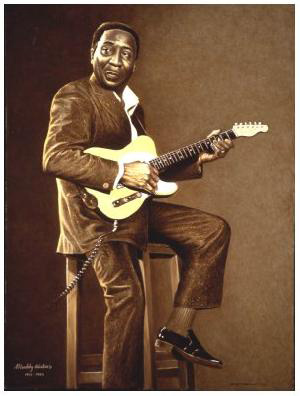
One of the pioneers of electric guitar-playing was Muddy Waters (left), 1915-1983, who moved up to Chicago to Mississippi.  In 1944 he bought his first electric guitar one made by Fender, and within two years had formed his first electric combo."

The article comes from:

THE ENCYCLOPEDIA OF MUSIC 
Max Wade-Matthews and Wendy Thompson
'Rock and Pop' on Leo Fender: Page 76. 
Hermes House
Anness Publishing Ltd (Print: 2003).


2) Birddog, a regular contributor and reader of this blog, has provided a comment about Leo Fender after the above article has been published. It is a big piece item so I've decided to give the writer ample space. Thank you Birddog:

"This unassuming giant of a man whose innovative inventions and contribution to the music world especially in guitars is legendary. Hardly there is any genre of modern music that is without an instrument synonymous with him.

Besides guitars, his company also made the equally famous Rhodes electric pianos and amplifiers which carried his name. To me I believe his single greatest contribution to the music world was his invention of the electric bass. Before he came out with that, the bassist had to stand immobile in a corner playing the massive acoustic 'doghouse' bass. It was huge and backbreaking to carry one around. 
After his success with the guitars, he came out with the electric bass thereby freeing the often ignored bassist to the forefront to share equal glory with the guitarist. Most of his inventions from the 50's were so bold and futuristic, that even today his iconic instruments are still highly popular and much sought after by many professional and aspiring amateur musicians alike. 

The legacy and footprint he left behind is immense. Not bad for a man who could not even play the guitar well. I believe he is the 1st non performer to be inducted into the Rock and Roll Hall of Fame."


Image: Louis Johnson and Leo Fender.
Louis Johnson (1955-2015) was an American bass guitarist, best known for his slapping technique and session playing with his group The Brothers Johnson. His was the best selling album of all time, Thriller and hits in the 70's/80's. His signature sound was from Music Man StingRay Bass which Leo Fender made for him to first use.

Read the story below about Mr Tan from TMA who sold the first Fender Solid Guitars in Singapore.

This posting neither promotes nor try to sell any product.

Thursday, January 21, 2016

Guitarists Henry Chua And Horace Wee Pay Tribute: Post II

The TMA logo on most of Mr Tan's shop offers. Pix by Gordon Pan from FB. He explains: "The guitar is a 1962 or 1963 Fender Jazzmaster identifiable by the Spaghetti logo bought from TMA around the same time. It was probably the 2nd most saleable Fender model at the time when Surf bands were using it instead of Stratocasters."

The Tributes:

The letters keep pouring in about Mr Tan in response to his passing away last week. Henry Chua, the former bassist of The Quests and Horace Wee, guitarist with RTS Orchestra, wrote a comment each for the blog and because both had much to share I decided to share their stories. Thank you, Henry and Horace.

Mr Tan of TMA by Henry Chua.
"My recollection of Mr Tan is still vivid in my mind. This man struck me as a kind and helpful human being.
I studied at Raffles Institution at Bras Basah Road in the 60’s. I was given just 20 cents for bus fare to and fro to school from my home in Tiong Bahru. Had to change buses for each trip. One the way home I need to take the STC bus from the St Andrew’s Cathedral and then changed to a No 6 Hock Lee bus at North Canal Road. Very often just to save 5 cents I walked from school to North Canal Road.
The walk was money saving and also it provides me some time to visit the music stores along the way. The first was Swee Lee at the Capitol Cinema complex. Then Sassoon, next to the Union Jack Club at the open car park next to Capitol. Sassoon was the importers of Vox guitars and amplifiers [image: Henry Chua].
The last stop was TMA at the junction of North Bridge Road and High Street. It was opposite the Metro departmental stores. There was also B.P. de Silva and Polar Café along TMA’s side of High Street.
I would always make a visit to the TMA shop to look and drool at the guitars. I was a 12-year-old kid and had dreams. There was a circular display in the middle of the shop. Vinyl record racks on the left and a glass showcase on the right as you enter the shop. On this glass case were displayed a few Fender guitars. 
I recalled seeing a Stratocaster priced around S$700, megabucks in those days for a kid with 20 cents in his pocket. There was a sound room to listen to the records you wish to purchase. I remembered the friendly uncle who put on a Dave Brubeck LP for me to listen. My first introduction to jazz including the 5/4 Take Five and 7/8 rhythm.
Some years later in 1964, we (The Quests) got to befriend Mr Tan. He was helpful and loan us the whole set of Fender guitars and amplifiers for our gigs. We just had to pick them up at his home along Mountbatten Road. That house is still there. He even allowed us to pay for the things we purchased from TMA by instalments. No contracts, just gentlemen’s honour.
He even rewired Reggie’s Stratocaster to achieve the neck and bridge pick up combination. He kept this rewiring secret between the Quests and him alone. That’s where we got our sound. Thanks to Mr Tan. Of course these days most would know how to acquire this fix. 
He was the service engineer for TMA. I usually find him in his little room fixing and repairing things. No matter how busy he was he would always find time to have a chat. He was a very patient man and I had never seen him enraged even on a difficult day.
We bought a Fender spring Reverb (S$400) from him and most of our guitars from him. At one stage he loaned us a Fender analogue tape echo to test, but unfortunately, there was just too much wow and flutter and the echoes were flat so we couldn’t use it. Finally, he imported the famous German-Swiss Echo and that was our tape delay for all our recordings since Shanty.
How could I not remember him as the friendly, kind uncle who helped us in our musical journey?

RIP Mr Tan, the Singapore music world loves you."


"Hi, Andy,
My take on Mr Tan of TMA 

This has to be one of the kindest persons I have ever known. Besides being a great salesman, he was able to relate to and support the young of that time who aspired to be a famous band or musician. The comments on your blog attest to this.

Every time I look at my Fender Twin Reverb, Stratocaster guitar and Swiss Echo machine (all of which I still own) I still think fondly of Mr Tan of TMA from whom I bought these instruments in the sixties. Much has been said on how he offered the Fender instruments on loan, instalment payments and other generous offers of sponsorship and promotion. 

But the friendship I formed with him was a passion for electronics and at that time the dawn of guitar effects pedals. He would share his information on circuits with me and likewise, I would do the same. 

When he was about to leave for Canada, he took the trouble to see me in order to introduce his US contacts to me in order that I might be able to have some business connections with them. Something that he did not have to do, but it illustrates the generosity and big-heart of this man [image: Horace Wee].

In all the years that I've been in music, there have been very few music stores or salespersons (IN THE WORLD) that I can say that I was happy to have bought from them. Mr Tan of TMA is one of them.

RIP M. Tan. It was a privilege to have known you, I shall never forget you and I hope to meet you or someone like you again, in some other lifetime.

Sincerely,
Horace Wee."

Part One Connection:
https://singapore60smusic.blogspot.com/2016/01/godfather-of-local-pops-tan-peck-soo.html

Images: A Private Collection.
Articles: Henry Chua and Horace Wee Copyrighted.

Saturday, January 16, 2016

Godfather of Local Pops: Tan Peck Soo TMA Music: Post I

MRS TAN PECK SOO passed away exactly 4 years after Mr Tan. A fine woman, she was 93. You may remember her as the elegantly dressed very friendly and soft spoken "hokkien" lady who stood behind the violin counter at the old TMA store on High Street. I bought my first guitar [a Harry Belafonte Calypso] round hole guitar from her. [From Henri Gann - 14 January 2021.]

UP TO 2,000 VIEWS, 30+ COMMENTS

I received a note from blog reader
Mr Henri Gann who announced the demise Mr Tan Peck Soo, former owner of TMA Pte Ltd. @ High Street, a music shop in the 1960's. Any band boy who played decent guitar would have met and known him. He was the Godfather of local 60's pop.


Mr Tan passed away on January 11th, 2016 in Vancouver B.C., Canada. A fine and generous man he was a friend to all who met him. He is survived by his wife, two sons, a daughter and two grand children. 

According to Mr Gann, he was the man who sold the first Fender Stratocaster and Fender Reverb in Singapore to pop guitar group, The Trekkers ( 1962 ).  Mr Tan and his equally enthusiastic electrician assistant helped the Trekkers build their first guitar amplifiers to simulate the sound of the Fender Showman and the Fender Bassman. 


Thank you Mr Gann for your personal tribute.

"The Trekkers tribute to the man they called Mr Tan of TMA (Pte) Ltd - Singapore 1960's.


Peck Soo had vision
The year was 1960. The 2 major guitar shops were Swee Lee and TMA. The former had an advantage guitar product being the sole agent for Gibson. TMA only had the Belafonte calypso guitars and ukulele and was focused on Hohner harmonica and accordion. 


I had just met Peck Soo. He had returned from a tour of the musical factories in Europe TMA represented. I showed him a Fender catalogue. He convinced his dad to import Fender even though Fender was a little unknown custom shop company in America. The Fender Stratocaster was later made famous after the death of Buddy Holly and the surfing music of the 60's. 

Peck Soo was a born banker
I was just a kid. Peck Soo offered me one of his first Stratocasters on credit. Buying things on credit was almost unheard of at that time least of all to a kid with no credit. The man knew relationship was key to business success.

Peck Soo was a gifted salesman
Store products were primarily displayed in the showroom and occasionally advertised in the newspaper for early Singapore. Peck Soo went a step ahead of the others. He had the Trekkers played his showcase amplifier on stage and especially at the British R n R club on Beach Road and the stores would be filled with British servicemen asking for the Fender products the next morning.

Peck Soo loved his electronics

He scanned his Heathkit catalogues daily like some people shop Amazon today and owning a Fender Showman and Bassman then was like having a Tesla today. Peck Soo saw it in our (Trekkers) eyes with the Fender amplifiers and said that he could build us one and he had a very sharp electrician who could do just that. Peck Soo knew his speakers well which was key to designing a good sounding amplifier and Geylang had great custom cabinet maker. The Trekkers build the first look alike and sweet sounding Fender tube amplifiers in Singapore in 1960.
Peck Soo was a funny man
We had one travel together from North America to Singapore. The year was 1985. Yes we did travel on SIA business class. Our first stop was Taipei,Taiwan. Peck Soo had his Sherlock Holmes rain jacket on and moved impatiently from one line to another as we were clearing immigration till I lost sight of him. 

When I found him after clearing customs he was the only person left at customs and they were making him empty his pocket and unroll his US$100 bills while another official was looking closely at his passport. He looked bewildered after the cross examination by customs.

Peck Soo said to me many times that he had a full life.
He was a good son to his father and moved to Canada only after his father decided to close down the business in 1980's. He immigrated to Canada to give his children and wife a better life. And he achieved his Canadian dream by having a good life in his retirement years. 

Thank you Peck Soo and I like to send this closing song tribute to you...
Would you know my name, if I saw you in heaven - Eric Clapton."


Eric Clapton's: Tears In Heaven: Tribute to Mr. Tan Video.  
YouTube Video from Epitaph.

Many band members from the 1960's are familiar with Mr. Tan. 
If you are, do write in to tell us.

Part Two:
Henry Chua (Quests) and Horace Wee (RTS Orchestra) tribute. Connect here:
http://singapore60smusic.blogspot.com/2016/01/guitarists-henry-chua-and-horace-wee.html

Further reading: 
http://singapore60smusic.blogspot.sg/2015/10/a-picnic-with-first-sg-chinese-guitar.html

Images: 1) Courtesy of Lee Kip Lin and National Library Board; 
             2) Henri Gann's Private Collection.

Video: YouTube by Toni Charlie - cs.

Article: Henri Gann Copyrighted.

Friday, April 06, 2012

RIP: Jim Marshall Invented Affordable Amplifiers

Based in Milton Keynes, England, Father of Loud has passed on at 88 years young. Jim Marshall invented an amplifer in the 60s cheaper than American made ones that were popular in the market then.
.
Peter Townshend, Ritchie Blackmore, John Entwistle of The Who, Slash from Guns n Roses, American-Blues rock guitarist Joe Bonamassa and bands like, Cream, The Jimi Hendrix Experience, Led Zeppelin were some of the musicians who used Marshall amplifiers.
.
As far as I can remember many of our local pop music makers use this brand of amplifier. Comment anyone? Check Jim Marshall out from the websites below:
http://www.guardian.co.uk/music/2012/apr/05/jim-marshall-amp-dies-88?newsfeed=true
http://www.adafruit.com/blog/2012/04/05/jim-marshall-creator-of-the-marshall-amp/

Saturday, November 12, 2011

It's Not Another Elvis Posting. Martin D28 Guitar

I have been asked many times if I play the guitar. Yes, I replied, but only using the 4 basic chords on C. Well, that's not too bad, some cynics replied, better than not being able to play at all. But deep within I know I can play more chords than that.

On another occasion, someone who has been reading my blog regularly (I have some blog fans too you know) asked me if I knew anything about musical instruments. A very superficial knowledge I said. Well, this gentleman replied, you need to write some articles about the guitar at least. What's a music blog without stories about musical instruments? True!

So with a mission to accomplish, I decided to buy another guitar to learn about the guitar and with the help of an exceptionally good lead guitarist from a Singapore 60s band (don't ever sound my name, he says) I went searching for one. And that was when I rediscovered the Martin D-28, one twang twang that I had salivated over for some time.

So without anymore fanfare, here's a brief from Internet websites and my own experience about this particular guitar that Elvis Presley fans will be definitely be familiar with (image 1). Or are they?

Do you own a D-28. Want to tell your story before I begin mine?
Image: From Scotty Moore's website: http://www.scottymoore.net/TributeD28.html

Friday, October 28, 2011

Change This Blog To An Internet Shopping Centre?

Maybe I should convert this blog into an internet shop like e-Bay or Amazon.com and start selling the products that I write about. Won't it be a great idea? Imagine the amount of money I can make with just a 10% cut. These letters below are just a few of the mail I have received where surfers and friends have requested to buy CDs, vinyls (records) and books. Here are some of the letters:

1) Just spent 60 Euros on a boring research book recently. This one sounds interesting. Any chance you could fly me a copy Andy? Will do an internet transfer from UOB. :)

2) I am Santhosh from India. I would be extremely grateful to you if you could help me get the MP3 of the following songs of Ervinna. I had a cassette which had 22 English songs of Ervinna, which got destroyed. I have managed to find 13 out of that 22 - but could not get the following 9 songs. I am ready to pay.

3) This musta be the Dinoref that you have mentioned to me... gonna have to see if I can gets my hands on one of Michael Goh's albums of Dinodevotion...

4) Wow, the book by Yusnor Ef is a major discovery for me. I have many songs from that era, now I need that book to accompany them. Please provide some info on where to buy it. Many thanks!

5) "Mary Ho Any chance you have a Red Fender Stratocaster in your collection? ; ) Also, you mind sending me an autograph version of your CD? I will do a $fund$ transfer from here if you don't mind.

6) Do you know of any other copies of the EP (The Diamond Four) that are in existence?

7) Mary Ho commented on a post you were tagged in."I don't have a red one at the moment but would love to own one if I can find it.:) I'm in London now, saw one at Harrod's yesterday but it's a three quarter size... I didn't buy it. Glad you mentioned my CD, will autograph it and send you a complimentary copy. Please let me know where I can send it to.:)"

No I'd rather leave it as a blog and make my usual comments about Singapore 60s music. So please keep on writing because this coming November the blog will be 3 years old. And I am not trying to promote it. Just having fun. And I probably won't earn 2 cents from it.

What do you readers think?

Images: from Google.

Original article: Andy Lim.

Wednesday, August 26, 2009

The Silver Strings Family At Orchid Country

Andy Young and The Silver Strings (image). Audie (right) is with his original Fender bass from the 60s.
Image: Veronica Young Collection.

Sunday, August 23, 2009

JET HARRIS 'BESAME MUCHO' FENDER BASS!

It's a Decca worth keeping, Jet Harris' Besame Mucho! There are not many of these singles lying around. The flip side is Chills And Fever (Thompson/Gray). Wow! And on Fender Bass too!

On April 29th 1962 with Charles Blackwell directing and Jack Good producing, his debut 45 vinyl Besame Mucho (45F 11466) was taped at Decca studios. It was a radically different sound experience to his earlier work with The Shadows.

Jet Harris was using a Fender VI Bass, tuned down an octave from the norm and gave the vinyl a deep and distinctive sound. Tony Meehan was on drums with his ex-colleague coupled with its female chorus backing and unique sound. Really special, heavy and hot!

The song written by Consuelo Velásquez from Mexico and based on, Quejas O La Maja Y El Ruisenor (The Girl And The Nightingale, 1941), a piano piece from 1911 by the Spanish composer Enrique Granados.

Harris and Meehan topped the UK Singles Chart in 1963 with Diamonds. Harris used the 6 string bass.

Reference/Article: You Tube by Pomesu/June, 10th, 2008.

Image: Andy Lim Collection.

Wednesday, June 17, 2009

The Shadows Versatility - Hawaiian Guitar Too

He plays bass for this group and also the hawaiian guitar for another band. He enjoys what he is doing and spends much time jamming with his friends when he is free. He has a large collection of guitars. Shadows' versatility too.

The Shadows Versatility - Leads 60s Music

Quiet, unassuming but friendly, George Chew only lets his fingers do the walking and talking when he leads the band with his versatility on the Fender frets playing, Apache, FBI, Kon-Tiki and other Shadows hits.
George is able to communicate well with his bassist, rhythmist and drummer and harmonise as a whole. What band is George with and who are his guitar mates? Check him out soon enough.
Image/Article: Andy Lim

Thursday, June 11, 2009

The Shadows + Fender Stratocaster = Apache

Released in July, 1960, Apache by The Shadows is the melody that inspired so many guitarists in Singapore and the world. It also helped to make the trademark Fender Stratocaster so popular and such a key element in 60s music.

Although expert guitarist Bert Weedon had already recorded and promoted it, The Shadows had the advantage of releasing it in the shops as a single, so when fans asked for it, they were offered The Shads' version. It triggered another two dozen hits by the famous four. Incidentally, Cliff Richard played the Chinese drums in the recording.

The rest is history and fellow followers, Clapton (Tears In Heaven) and Knopfler (Sultans Of Swing) turned to a Fender Strat.
(Original article. Information from: Music edited by Sean Egan. Image: http://www.iansamwell.com/)

Monday, March 16, 2009

FENDER Amplifiers 60s- Still Screaming Today!


The experts call it the legendary Fender Reverb amplifier and combined with either the Fender guitars or even the Hofners, produced sounds so unique that they echoed within the 60s concert halls and were eventually immortalised on vinyl records.

Hofners were popular and relatively inexpensive when compared to the Fenders. They produce great sounds too. But amongst the band boys the whisper was, "Nothing like a Fender!"

A Singapore guitar group in the 60s usually started off with a Hofner and after many gigs to its name might end up buying a Fender. While a Fender would cost $800 then, a Hofner was cheaper. But the sound's different.

FENDER/VOX SHADOWS COMBINATION WOWS


Vox Amplifiers 60s Music Influence Singapore


The SHADOWS, 60s guitar group from the U.K., had the greatest influence on many of the groups in Singapore. Apparently the VOX - AC-30 amplifier and the Fender Stratocaster guitar is the dream team for many would be band enthusiasts. It is the most lethal combination to be heard when groups played on stage.
Many groups were not able to buy this expensive combination and tried to get away with cheaper versions but Singapore's guitar group competitions, so common those days, held many to ransom. Since talent contests were also talent spotting by recording companies many groups took them seriously. Some groups managed to buy these expensive instruments, otherwise they would not have seen the light of day let alone the lights on stage.
There were other guitar/amplifier combinations and many of them were just as good. Are you familiar with the instruments the groups used then?
YouTube: Key in: shadows apache

Friday, January 23, 2009

Silver Strings Chinese New Year Kowloon Room

Danny Boy (drums), Wilfred Chew (rhythm), Andy Young (vocals), Audie Ng (bass), David Chan (lead). 

During the Chinese New Year 1964 season, we were known as, Andy Young and The Silver Strings, showered our music in many Chinese-styled environments before the band acquired recording contracts from Philips. The Kowloon Room was one interesting restaurant where we performed at. It was at the Capitol building and this was the original SS line-up that took off in 1964.

Free, fun-loving and fresh our group looked resplendent in dark suits with clasp-ties and shoes to match. From the right was David Chan the lead guitarist, smiling and about to begin our performance that evening. 

Then the bass and boss Audie Ng with his usual thick locks and heavy solid guit. On the mike, myself. Our Fender guitars except for Ah Chew's rhythm guitar, a semi-solid, were relatively brand new and the amplifiers on stools were Gibson. Danny Boy in the corner looked set to bang the skins and clash the cymbals.

Wished the image had been in color. Then we would have been appropriately called, "The Kowloon Silver Strings Quintet".

The little banner on the left announced, "1964". Pictures tell true tales too. Some of the Silver Strings black and white photographs were used in books but printed without our permission.

Thursday, January 01, 2009

Andy 60s Fiat 600 1964 Model Silver Strings Overload

#This story was featured on 9th November 2014 during Brian Richmond's 90.5fm radio show, Sundays With Brian during the Reminiscing with Andy segment. 

A Memory Trail:

We didn't know how but Audie, bass guitarist of the Silver Strings, owned a Fiat 600 in the 60s and the 5 or 6 of us squeezed into the tiny car with two doors.

We were entangled all over like a human octopus, limbs dangling, with probably three sitting in front and four seated behind, with at least 3 Fender guitars, a snare drum, and sticks. We knew how sardines felt after that. Compact travel. It was fun though as our driver went round before that picking everybody up. The cramping got worse as the numbers increased.
Wilfred, Danny Boy, Andy, Audie and David during one of the first few gigs at the old Kallang Airport Dance Hall.


If I remember correctly, the usual troupe was in the car, handsome Hainanese boy David Chan lead guitarist, Wilfred Chew rhythm, the rich young man from a bungalow house in Katong, 'Danny Boy' or Osman our drummer and our taxi-driver Audie Ng who owns the car, the band, and the bass. 

Somewhere in that mess, I was inside too. Five so far. Sometimes a fan would come in; he would help carry our guitars. You wouldn't believe it but the car can take in five people easily.

Audie still does it now, picking band members up and sending them way back home in the night from as far as Yishun and Pasir Panjang. I remember him driving home the band boys after our studio practices in November 2008. He drives a bigger car now. This particular car took us home during the racial riots (check postings) in 1964.
I bought one in the mid-60s too. Kiasu. Red in color; no choice. Second hand. The above illustration shows the two doors opening V-shaped, facing the engine. They were wide when opened, very wide indeed. It was easy to enter and exit the car because of the wide gaps the two doors made (image). 

Once I fooled a friend, telling him that the Fiat 600 didn't use any engine [image below]. He was shocked when I opened the front bonnet to prove it. The space for an engine was empty. If only I had shown him the boot, where the engine was. 😂
Good old Eddie is still around today. I'm just wondering if he knows...

My first car ever!

The engine is behind? Fooled a friend who was shocked
when he saw there wasn't any...

Classic Cars and Music of the 50s
YouTube Video from: 1970s English Teddy Boys
This fantastic video took a lot of patience and energy
to produce. Thank you very much guys.


With Brian Richmond during the recording session 
at MediaCorp which was at Caldecott Hill. He is a DJ at Singapore's 90.5 FM Radio Station.


Image: Google and A Personal Collection.

This post has been rejuvenated from 1.1.2009.