Saturday, April 11, 2009

(1) Singapore 60s Idol Mark Yun & Moonglows

He's back and this posting is one part of a series because MARK YUN was a big star from 1962 onward after winning a radio talentime contest produced by the late Steven Lee (radio programmes producer and announcer).

The above record was his second one with his own composition, I've Got A Feeling Tonight. He was accompanied by The Moonglows.


Mark Yun, accompanied by The Moonglows, with Sunny Bala behind Mark, in 1968 (b/w image) and The Thunderbirds with Harvey Fitzgerald at The Sheraton in 1974.

Asked why he did not turn professional, Mark's answer was simple, "Those days, the market for music in Singapore was limited and it would not have been practical to take it up professionally. Maybe if it was in Europe or America where several kinds of music can exist side by side, I might have been able to make a living out of it."

Notice the Fender amplifiers and guitars in the b/w image which were the order of the day.

(Above extract: Andy Lim's interview with Mark Yun. All rights reserved.)

____________________________________________

From Straits Times Press (Freddie Kang's Facebook)
FLASH NEWS!

Mark has passed away on 19th June, 2014. My promises to meet him for kopi and lunch never came about. I should have done so when he suggested it. I read about his passing only today 23rd June, 2014 from Freddie Kang's Facebook.

Rest In Peace Mark. You're a quiet guy but a great singer. Thanks for the photographs and copy of your record you lent me for this blog when we last met in 2009.

Mark was one of the first few singers who recorded with Philips during the early years of Singapore's popular music era. He was a school teacher and dedicated his time to both his career and his singing. 

Condolences to Mrs Yun and the family.

Friday, April 10, 2009

American Idol: FRANKIE AVALON - U.S. 60s


He appeared this week on American Idol screened in Singapore on the Star World Channel and sang the world evergreen, 'Venus'.

Francis Thomas Avallone (born 1939) was an American actor, singer and teen idol in the 1950s and early 1960s. By the time he was 12, Avalon began making appearances on U.S. television for his trumpet prowess, and as a teenager, played with Bobby Rydell in a band known as Rocco and the Saints.

In 1959, his songs "Venus" and "Why?" both went to number one on Billboard magazine's Hot 100. Indeed, "Why" was the last Number 1 hit of the 1950s. During the 1960s, Avalon became known for his roles in the Beach Party film genre.

Frankie Avalon married a former beauty pageant winner, and Avalon met her while playing cards at a friend's house. He told his friend that Kay was the girl he was going to marry. His agent warned Avalon not to marry as it would spoil his teen idol mystique, but Avalon ignored his advice. Still together, the couple has 8 children and 10 grandchildren.

In 1987 Avalon and Annette Funicello returned to the movies, with the aptly titled 'Back to the Beach'. With the fading of his music and acting career, Avalon has turned to marketing and has created Frankie Avalon Products, a successful line of health supplements and cosmetic products.

He regularly guest stars in stage productions of 'Grease' in the role of Teen Angel (a role he played in the film version starring John Travolta and Olivia Newton-John).

(From: Wikipedia)

U.S. 60s Influence - Groups - Kingston Trio'

KingstoneThe youths growing up in Singapore 60s could sing, hum or whistle, "Tom Dooley". The Kingston Trio was formed in 1957 and by the following year had this very successful single at the top the pop charts. The trio, though certainly more commercially viable than some of the more authentic folkies of the late '50s, had a lot to do with the success of the folk revival in that era; folk music rang out from college campuses everywhere in the late '50s and 60s.
Whether or not they knew their music was paving the way for artists more deeply involved in these changes (Bob Dylan, Joan Baez), it did sell plenty of records. The Kingston Trio began in San Francisco.
Their first album, THE KINGSTON TRIO, included "Tom Dooley" and it was played extensively by DJs that Capitol released it as a single that eventually sold nearly 3 million records. The song was taken from a 19th century mountain ballad about Tom Dula, who was hanged for murdering his sweetheart.
Several albums ensued for the trio, all doing well commercially but, while it had 10 singles charted by 1963, only "Reverend Mr. Black" got into the Top 10. However, the Kingston Trio is remembered for other tunes like "M.T.A.," "The Tijuana Jail," "A Worried Man", "Greenback Dollar" and Pete Seegar's, "Where Have All The Flowers Gone?" Like "Tom Dooley", it's another pop hit turned classic.
As the more intensive folk-rock grew, making songs like the Kingston Trio's became outdated and the trio broke up in 1968. A TV reunion in 1981 had all six members together for the first time.
Whether duos, trios, quartets or quintets, the influence of vocal groups like THE EVERLY BROTHERS (2), THE KINGSTON TRIO (3), THE BROTHERS FOUR (4), THE PLATTERS (5), certainly made an impact on our local music scene. Carbon copies or otherwise our 60s musicians certainly learnt a lot from their US counterparts.
(From: Kingston Trio Website).

- U.S. 60's Music Influence - BROTHERS FOUR -


"Twas so good to be young then,/ In the season of plenty,/When the catfish was jumping as high as the sky.../To be close to the earth,/And to stand by your wife at the moment of birth," (The Green Leaves Of Summer) are lyrics that can only come from four singers who called themselves, THE BROTHERS FOUR.
This vocal foursome is one of the sources of inspiration for many of our Singapore vocal groups. The Brothers Four is a pioneering and long-running folk/pop quartet formed in 1957 by the University of Washington fraternity brothers Bob Flick (upright bass, vocals), Mike Kirkland (guitar, banjo, vocals), John Paine (guitar, vocals) and Richard Foley (guitar, vocals).
They were spotted when playing in San Francisco in 1959 and secured a contract with Columbia Records. Their second release, "Greenfields", shot to number 2 in the US charts. This beautiful and haunting song came from the pen of Terry Gilkyson of the Easy Riders, who had written major 50s hits such as "Memories Are Made Of This" and "Marianne".
The folk-based foursome, who were voted America's "Most Promising Group Of 1960', were quickly established as one of the leading folk revival scene alongside the Kingston Trio and the Limeliters. Their first two albums, The Brothers Four and B.M.O.C. (Best Music On/Off Campus), reach the US Top 20. They had eight more lower placed albums and half-a-dozen smaller US hit singles, and reached a peak when they recorded the theme tune to the ABC network folk music series Hootenanny.
The emergence of Bob Dylan and a highly politicized folk movement, coupled with the British beat group invasion of the mid-60s made the Brothers Four" brand of easy listening folk instantly passé.
The original line-up carried on until 1969 and after a number of replacements the quartet survived the 70s and 80s through extensive touring, and resumed recording the following decade.
And my favourite songs? Greenfields, Green Leaves Of Summer, Yellow Bird.
(Edited and extracted from: 'The Encyclopaedia of Popular Music' by Colin Larkin)

Thursday, April 09, 2009

Singapore 60s - JAMES CHOA with The Gaylads

Yes, GayLads but they are far from being 'gay' because the word simply means 'happy' in the good old days. And happy were the folks who watched them for the first when they participated in the Singapore Blue Diamonds Competition in the early 60s. They clinched the title with The Antarctics acquiring second place.

Andy Lim interviewed JAMES CHOA (image: front) recently when he related his musical experience and career as a member of the GayLads and The Flamingos Combo.

"I started singing at the age of 17 in 1959 as a singing group called, The Gaylads with classmates, Philip Goi, Charles Koh and Razak Rahman (image: from left). We won a few talentime contests including the title of "The Blue Diamonds of Singapore" when both The Blue Diamonds and Anneke Gronloh were in Singapore. They were part of the panel of judges for the competition.

After winning the title we were featured in the first few RTS (Radio, TV, Singapore) shows called POP INN and DENDANG RIA. We sung for the very first LIVE show in Singapore, produced by well-known ballet dancer, Mr Vernon Martinus.

In the mid-60s the group enlarged from a singing group to a combo band and included in the group was Jimmy Chan, pianist (currently at Marina Mandarin Hotel), Audie Yusoff and Sidek (took turns to play lead guitar), Tommy Tan was at the drums and Robert Song, percussionist/singer. The combo carried on till 1970 but was disbanded because Charles Koh went into the medical profession and became a successful gynaecologist in the U.S.

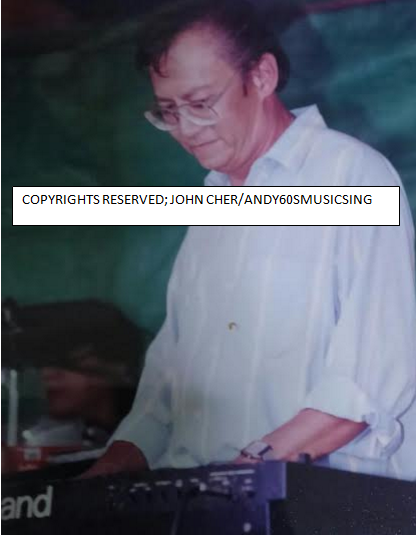
I became a teacher and subsequently a sales person at an MNC. Since my first love is music, I learnt to play the keyboard and joined another group called, "The Mysterians" but we played only for private functions and at the camps at Sembawang.

As the years passed, I played and sang at the restaurant called, "House Of Peranakan" at the former Hotel Negara when it was first opened in 1998. I am still performing there now but the hotel has a new management and it is called The Claymore. I used to play every night but during the latter part of 2006 I performed only thrice a week.

Jimmy is now a full time pianist at Marina Mandarin. Philip, Razak, Sidek and Tommy as far as I know, are still actively involved in their own business or working with some companies. Audie Yusoff has passed on."

And what is one wish that James has today? "To continue playing on the keyboard and sing. Do come to see me at The Claymore Hotel and enjoy peranakan* food too. Great combination!"

For your information James plays, standards, jazz, country, rock and roll, especially hits from the 50s and 60s. For some musical memories check him out!


Off the cuff: After winning the Singapore Blue Diamonds contest, James Choa and the rest of The Gaylads (popular 60s group with The Flamingos) were given a singing contract and arrived in style at the Merlin Hotel in Kuala Lumpur, to be resident vocal group at the Harlequin Room with a full band to accompany them.

They were driven all the way, by car from Singapore to KualaLumpur, Malaya, by Tan Swee Leong at the helm of his Ford Anglia. Mr Tan, a Rediffusion Cable radio celebrity himself, was also the MC for their shows and James remembered they had a fascinating 3 weeks at the hotel.

Since it was the 'they had time to see the sights in KL during the day and had comfortable accommodation at the hotel itself. Besides a full allowance, The Gaylads were also provided with whatever creature comfort they needed during their stint at the Merlin.

*Peranakan food is Chinese/Malay cuisine which originated from Malaka (Malaysia) and Indonesia.

SLIP NOTE: (4 years have passed.)

"I met James again the few years before he passed away.  It was a long absence. He was living up North and I had to drive quite a distance to meet him.  As usual James was warm and kind, always insisting that I go into his room where he would play with his new Yamaha keyboard which he had bought not too long ago. He had his music books ready, his song sheets and the new shiny microphone on a stand close to his keyboard.

He made sure I knew my chords before we started on a song and when everything was ready and he was satisfied he would ask me to sing my favourites.  He would always provide an appropriate introduction especially if he knew the song. The standard pieces were never a problem since James played nearly every night at lounges, nightclubs and stages all over Singapore when he was active with the Flamingos and his own group The Gaylads from the 50's to the 80's or 90's.

At his home, I would sing my usual songs and James never tried to check me or advise me in any way, except only when I asked him.  So it was like, "Yes, that's a great song, so try to give it more depth by putting in more feel to this part..."  Or, "Why don't you try a higher key?" Otherwise we would just relax and try out as many songs as we could.

He looked relaxed with his new keyboard but I knew he was suffering within, what with his ailment and his inability to move about too much.  Deep down was a man so engrossed in his love for the music that it must have helped him along day by day.  James suffered much when he was still alive but he never showed signs of despair or frustration.  He was always happy, positive and ever ready to play for his next gig or private party.

James had to travel a long way to the place he played which was at Orchard Road. He also had to pay a lot of money for his taxi fares.  But the journeys and time he took was worthwhile since it distracted him from his own ailment. I have always thought that the amount he received as payment was far from what he should be getting. From my observation (I may be wrong), it only covered his cab fare with a few dollars left for him. And his fare from the North to Orchard Road was exorbitant.

When he called me on the phone it was always with his peranakan greeting.  It would always be, *"Apa macam baba? Bila lu mau datang sini? Come over now."

There were many times when I could not oblige him because I was busy with home and the grandchildren but there were occasions when I drove to his work place to see him play but honestly, it was few and far between. I should have visited him more often.

On the day he passed away, he was going to play at a party somewhere and I remembered he told me about it. But he never made it. The party he was going to was a bigger one with the Lord to care and look after. Rest in peace James; we love you very much when you were around and love you just as much now you're not."

*How are you brother. When are you coming here? (Translated from Malay.)

An Original Article (Copyrights Reserved).

Singapore's Pop 60s Music Culture & History?

For the high brow, the intellectual, the uninitiated or anyone eager to delve into Singapore's music scenario the list below might help:

Chen, Andy & Mosman Ismahil , eds. No finer time to be alive?: voices of Singapore's English music. Singapore: Simpleman Book, 1996. 211p. [ML345.12 No]

Chua, Henry . “Call it Shanty!”: the story of the Quests. Singapore: Options Publications, 2001. 185p. The story of one of the greatest pop bands of the sixties. [ML421 Que.Ch]

Ho, Wai Chee . Sub-culture of rock music in Singapore. Singapore: University of Singapore, 1979. 98p. Academic exercise - Dept. of Sociology, Faculty of Arts and Social Sciences, University of Singapore, 1979. [HM15 *1979 7]
Kong, Lily . Popular music and a 'sense of place' in Singapore. Crossroads, 9(2):51-77, 1995. [DS501 JSA]
Lockard, Craig A Dance of Life: popular music and politics in Southeast Asia. Honolulu, HI: University of Hawaii Press, 1997. 390p. Explores the connections between popular music genres and politics in Southeast Asia, with particular emphasis on Indonesia, the Philippines, Thailand, Malaysia and Singapore. Has a chapter entitled “Malaysia and Singapore: pluralism and popular music” (pp.207-261). [ML3502 Sou.Loc]
Pereira, Joseph C. Legends of the Golden Venus. Singapore: Times Editions, 1999. 127p. A collection of interviews, commentaries and photographs illuminating the history of Singapore’s pioneering rock ‘n’ roll and R&B bands of 1960s. [ML345.12 Per]
Phua, Siew Chye & Kong, Lily . Ideology, social commentary and resistance in popular music: a case study in Singapore. Journal of Popular Culture, 30(1):215-31, 1996. [AP2 JPC
Image: copland.udel.edu Book titles: nlb singapore.

Wednesday, April 08, 2009

50s/60s Music Scene The Platters "Only You"

Remembering Tony Williams, lead tenor, was not a problem especially when he was a 50s singer in one of the most renowned vocal groups in the U.S. and possibly the world . David Lynch, Paul Robi, Herb Reed and Zola Taylor were THE PLATTERS. And "Only You", their first song, became a Top Ten on the charts for weeks.
Then came "The Great Pretender" and a string of other hits that are still being played around the world today. They appeared in the movie, "Rock Around The Clock" with Bill Haley's Comets together with a host of other rock and roll greats. The Platters recorded about three dozen songs and most have lasted generations and become evergreens.

"Buck Ram is remembered for his long association with The Platters, whom he signed to a management contract in 1953. Ram was working as a talent manager, A&R man and saxophone player in a dance band when Tony Williams, the brother of one of Ram's clients, auditioned for him. Ram was looking for a group to sing the songs he wrote and found the voice he was looking for in Williams.

He built The Platters around him. Ram arranged and produced all recordings by The Platters, from their signing with Mercury Records until his death, and wrote their biggest hits including Only You (And You Alone), The Great Pretender. Magic Touch, and Twilight Time."

From: http://religion.wikia.com/wiki/Buck_Ram

During the Singapore 60s music scene, our local boys and girls formed vocal groups too and the more popular ones were, The Tid-Bits, The Crescendos, The Three Bambinos and The Gay Lads (Gay = Happy).

Key YouTube: the platters twilight time.

By: Andy Lim

Sunday, April 05, 2009

Pop 60s Music - Jose Feliciano - Light My Fire

From 1964 to 2008, Jose Feliciano is still performing and sings both in English and Spanish. As versatile on the guitar and with a voice just as powerful and rich, his concerts are always a sell-out.
By: Andy Lim

"Why Singapore Rocks" Article By Carol Cooper.

"Why Singapore Rocks" by Carol Cooper.
Extract One:
A contentious and solidly middle-class rock underground exists in the island nation of Singapore. It's unofficial mission? To keep alive a diversity of creative expression and dissent that was all but paved over during S'pore's 30 year rush to become a fully competitive First World nation.
Having been a multi-ethnic center of global trade and culture since the 1500s, the Malaysian peninsula - to which Singapore is attached like the dot of an exclamation mark - has long been a dynamic cultural melting pot even more fervid than our own....
Extract Two:
By using Pony Canyon resources to host and film band showcases at Fire Disco and the Substation, Jimmy Wee is generating the promotional tools the local underground has always needed. "I believe the Singapore scene can happen because I've seen how Hong Kong and Malaysia have come along,"
Wee insists. "Fifteen or twenty years ago, Hong Kong was a hopeless market. A lot of the Hong Kong artists were nothing until there was this big hype about Cantonese pop singers. What made these artists happen was media support. If you're in Hong Kong, you pick up every magazine and you'll see all these local stars in color. You turn on the radio or TV and you'll hear these same stars! "
He concluded and exclaimed, "So I've been making noises about that here to all the local radio and tv people. There's no harm in promoting international music, it's good because we learn from them. But don't forget the local music!"
(Read the full article on her Website.)
(1) Didn't our 60s pop groups start it all?
(2) Do you agree with the article?

Malaysian Alfred Ho: It's His Vocals Not His Visual


ALFRED HO is the consummate entertainer with over three decades of performing experience at numerous stageshows, private functions and nightspots across the country. Although blind he has endeared himself to audiences for his interpretations of evergreen numbers from legendary crooners Elvis Presley, Cliff Richard, Tom Jones, Engelbert Humperdinck, and various country and western performers.

Alfred's mellow but powerful voice is irresistible to those who long for the days when songs had words you could actually hear and appreciate - a time when melodies were not obscured and drowned by crashing guitars, pounding beatboxes and techno rhythms.
This Perak-born (from Penang) performer continues to surprise audiences wherever he goes with everything from soothing ballads to rock and roll and even throws in some Spanish, Malay, Cantonese, Japanese and Hokkien numbers to prove his diversity.
Listening to the talented Alfred is a walk down memory lane, reviving gems from past that you may not have even heard on the radio of late. Alfred has such a wide repertoire that he has been known to play for four straight hours, with still some songs to spare.

Struck blind after a bout of measles at the age of three, Alfred showed a love for music from an early age. At Penang's St Nicholas School for the Blind, he taught himself to play the guitar and formed a four-piece schoolboy band called The Sharks. He later honed his craft doing the pub circuit as a solo guitarist and developed an uncanny sense of being able to 'read' his audience from the stage.

His first brush with fame came as a semi-finalist in RTM's Bakat TV, the popular talent show of the 70s. Alfred also did a few shows called Take Five with a commercial broadcasting station in that period and even cut two EP vinyl records of his own compositions.

Two songs, Train To Tennessee and Wendy's Love Song (above vinyl) were particularly popular and he recorded several cassettes back then that were played on local airwaves.

In 1984, having garnered a following and dubbed Malaysia's Jose Feliciano, Alfred finally quit his steady job as a telephone operator and went into music full time. A decade of performances later, during which no record label was willing to sign him on, Alfred self-produced an album of 22 covers of his favourite hits called "Special Gems".

Today, his loyal fanbase, from ambassadors to royalty, from vinyl connoisseurs to lovers of classic dancing, still speak of Alfred with fondness and continue to enjoy his special brand of music.

(From Website: National Council For The Blind, Malaysia/Majlis Kebangsaan Bagi Orang Buta Malaysia).

Images: From You Tube and Andy Lim Collection.

Check his videos: http://www.youtube.com/watch?v=8Q9gkJ41mhY